JC Mbonicura, A Nzunogera, JB Bizimana, A Ndayikengurukiye, RA Iradukunda, D Nihimbazwe, L Ndayisaba
22-May-2026
Introduction: First aid (FA) is essential for saving lives and preventing deterioration of victims before hospital care. In Burundi, FA is not yet integrated into the medical curriculum despite its importance in a context where the prehospital care system remains underdeveloped. This study aimed to assess the knowledge, attitudes, and practices of medical interns regarding first aid. Methodology: A descriptive and analytical cross-sectional study was conducted between May and July 2023 among 240 medical interns from the University of Burundi, the University of Ngozi, and Hope Africa University. Data were collected using a structured online questionnaire based on the Africa First Aid Materials (AFAM) reference and analyzed using SPSS version 27. Results: Only 30.8% of participants demonstrated a high level of knowledge in first aid, while 62.9% had a moderate level and 6.2% a low level. Prior training in first aid was significantly associated with better knowledge (p < 0.001). The best performed topics included external bleeding management (87.9%) and fracture recognition (95.4%), whereas initial assessment priorities (18.8%) and shock management (28.3%) were poorly mastered. Most participants (81.2%) supported the integration of first aid training into the medical curriculum. Conclusion: Medical interns in Burundi show insufficient knowledge of first aid. The integration of structured training into the medical curriculum, combined with initiatives such as Red Cross clubs and refresher courses, is necessary to improve these essential skills.
First Aid, Knowledge-Attitude-Practice Study, Medical Students, Burundi
Introduction : Les premiers secours sont essentiels pour sauver des vies et prévenir l’aggravation de l’état des victimes avant leur prise en charge hospitalière. Au Burundi, malgré leur importance dans un contexte de sous-développement du système de soins préhospitaliers, les premiers secours ne sont pas encore intégrés au cursus médical. Cette étude visait à évaluer les connaissances, les attitudes et les pratiques des internes en médecine concernant les premiers secours.
Méthodologie : Une étude transversale descriptive et analytique a été menée de mai à juillet 2023 auprès de 240 internes en médecine des universités du Burundi, Ngozi et Hope Africa. Les données ont été recueillies à l’aide d’un questionnaire en ligne structuré, basé sur le référentiel Africa First Aid Materials (AFAM), et analysées avec le logiciel SPSS version 27.
Résultats : Seuls 30,8 % des participants ont démontré un niveau élevé de connaissances en premiers secours, tandis que 62,9 % présentaient un niveau moyen et 6,2 % un faible niveau. Une formation préalable en premiers secours était significativement associée à de meilleures connaissances (p < 0,001). Les sujets les mieux maîtrisés étaient la prise en charge des hémorragies externes (87,9 %) et la reconnaissance des fractures (95,4 %), tandis que les priorités de l’évaluation initiale (18,8 %) et la prise en charge de l’état de choc (28,3 %) étaient mal maîtrisées. La plupart des participants (81,2 %) étaient favorables à l’intégration de la formation aux premiers secours dans le cursus médical.
Conclusion : Les internes en médecine au Burundi présentent des connaissances insuffisantes en premiers secours. L’intégration d’une formation structurée dans le cursus médical, associée à des initiatives telles que les clubs Croix-Rouge et les stages de recyclage, est nécessaire pour améliorer ces compétences essentielles.
Mots-clés : Premiers secours, étude Connaissances- Attitudes-Pratiques, étudiants en médecine, Burundi.
Life-threatening emergencies, defined as conditions that may rapidly worsen and lead to death, remain a major public health challenge [1, 2]. Trauma and cardiac arrest, frequently encountered in prehospital settings, require immediate intervention, often by bystanders. First aid interventions applied in the first minutes significantly reduce mortality and improve patient outcomes [3, 4]. In high-income countries, such as France, first aid training is integrated into education systems and recognized for its social impact [5].
International studies, including those conducted in the United Arab Emirates, highlight the importance of first aid training for medical students, who are expected to play a key role in emergency response [6, 7]. However, several African studies report insufficient knowledge among health science students despite their future frontline role [1].
In Burundi, where structured prehospital emergency systems are still limited [8], first aid training is not systematically included in medical education. In this context, and in line with the memorandum of understanding between the Burundi Red Cross and the Ministry of Education promoting first aid integration [9], this study aimed to evaluate the knowledge, attitudes, and practices of medical interns regarding first aid.
This study was a descriptive and analytical cross-sectional survey conducted from May to July 2023 among medical students in their clinical years (4th to 6th year) from the University of Burundi, University of Ngozi, and Hope Africa University. The sample size was calculated using François Daniel’s formula, with a 5% margin of error and 5% non-response rate, resulting in 200–311 expected participants. A total of 240 students participated after informed consent.
Data were collected using an anonymous online questionnaire (Google Forms) developed from the Africa First Aid Materials (AFAM) reference. The questionnaire included 20 knowledge-based questions covering key first aid topics, including the RICE protocol (Rest, Ice, Compression, Elevation) for sprains.
Variables studied included socio-demographic characteristics (sex, university, and academic level), exposure to first aid training, sources of information, practical experience in first aid, reasons for nonperformance of first aid, and opinions regarding the inclusion of first aid training in the medical curriculum. The main outcome variable was the level of knowledge, scored out of 20, converted into percentage, and categorized into low, moderate, and high levels.
Data analysis was performed using SPSS version 27. Categorical variables were expressed as proportions, and continuous variables as means ± standard deviation. Chi-square tests were used for bivariate analysis, and variables with p < 0.20 were included in a multinomial logistic regression model to identify independent factors associated with knowledge level. Results were expressed as adjusted odds ratios (AOR) with 95% confidence intervals. Ethical approval was obtained from academic authorities, and data collection was facilitated through internship group coordinators.
In our cross-sectional study conducted among 240 medical students in Burundi (response rate: 50.4%), we described the knowledge, attitudes, and practices regarding first aid. Descriptively, the majority of respondents were from the University of Burundi (58.75%), followed by the University of Ngozi (34.17%) and Hope Africa University (7.08%). Final-year students represented 41.25% of the sample, followed by fourth-year students (30.00%) and fifthyear students (28.75%). Males were predominant, accounting for 68.33% of participants.
Almost all participants (94.17%) had already heard about first aid practices, mainly through school (41.59%), hospitals (37.61%), media (36.28%), and first aid training sessions (36.28%). However, 56.67% had never performed any first aid action. In addition, 81.2% of students expressed a positive opinion regarding the introduction of first aid courses into the medical curriculum.
Regarding knowledge assessment, 43.75% of students correctly identified the chronological order of emergency management (protect, assess, alert, assist). In triage situations, 49.17% prioritized severe bleeding, while 36.25% prioritized unconscious patients with absent breathing. The correct initial assessment sequence was identified by 63.33% of respondents. The Heimlich maneuver for airway obstruction was known by 80.83% of students. External bleeding control through compression was correctly identified by 87.92% of participants.
In cases of epistaxis, only 41.67% adopted the correct management, consisting of compressing the nasal cartilage while leaning the head forward. Management of shock was poorly understood, with a high proportion of incorrect or incomplete responses. Regarding fractures, 95.42% of students correctly recognized the main clinical signs. The RICE protocol for sprains was identified by 77.92% of respondents. For superficial burns, 74.58% knew that cooling the affected area was the appropriate first action.
However, 62.08% of participants incorrectly believed that an object should be placed in the mouth during epileptic seizures. The FAST method for suspected stroke was recognized by 66.25% of respondents. Proper management of wounds with foreign bodies was correctly identified by 57.50% of students. In cases of poisoning, 60.00% correctly opposed inducing vomiting. Cardiopulmonary resuscitation (CPR), with a cycle of 30 compressions for 2 ventilations, was known by 76.25% of participants. Regarding snakebites, 55.83% rejected the use of the “black stone” method. Finally, 49.58% incorrectly believed that tourniquet use should be systematic in all bleeding cases.
On the analytical level, in our study, bivariate analysis showed no significant association between sex and knowledge level (p > 0.9). However, a statistically significant association was observed between knowledge level and university of origin (p < 0.001). Multinomial logistic regression analysis identified factors associated with knowledge level.
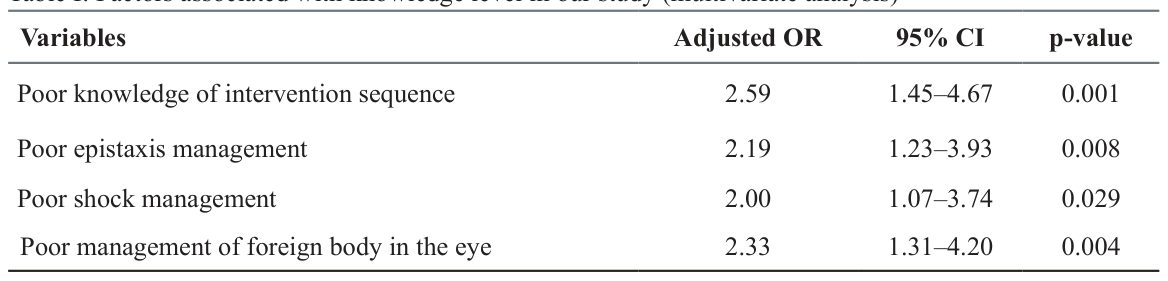
The multivariate analysis showed that inadequate knowledge of the emergency sequence, epistaxis management, shock management, and foreign body eye injury management were independently associated with the level of knowledge, with statistically significant adjusted odds ratios.
Table I: Factors associated with knowledge level in our study (multivariate analysis)
This study assessed the knowledge, attitudes, and practices of medical interns in Burundi regarding first aid. Among the 240 participants, the majority were from the University of Burundi (58.75%), followed by the University of Ngozi and Hope Africa University. Final-year students were the most represented (41.25%), and males accounted for 68.33% of the participants. No statistically significant association was found between sex and level of knowledge, consistent with findings reported in the Democratic Republic of Congo [1].
Almost all participants had already heard about first aid practices, mainly through school, hospitals, media, or specific training sessions. Most students expressed a favorable opinion toward the integration of first aid training into the medical curriculum, in agreement with studies conducted in Africa [10–12]. In addition, previous exposure to first aid training was significantly associated with a better level of knowledge, similar to findings reported by Khan et al. [13].
Overall, knowledge levels were classified as high in 30.8% of students, moderate in 62.9%, and low in 6.2%, findings comparable to studies conducted in other countries [1, 14, 15]. Regarding first aid knowledge, less than half of the students correctly identified the chronological sequence of emergency management, and only a minority adequately mastered the initial assessment of a victim. These results were lower than those reported in Syria by Aljarad et al. [14].
Nevertheless, satisfactory knowledge was observed for some essential first aid measures, particularly the Heimlich maneuver for airway obstruction and external bleeding control. Similarly, fracture recognition, sprain management using the RICE protocol, burn management, and stroke identification using the FAST method were generally well understood.
However, important gaps remained regarding the management of epistaxis, shock, epileptic seizures, and the inappropriate systematic use of tourniquets. Cardiopulmonary resuscitation knowledge was acceptable in most participants, although not optimal. These findings suggest that students possess partial theoretical knowledge but still lack comprehensive and structured first aid training.
The response rate of this study was 50.4% (240/476), which may have introduced response bias. Students who were more interested in first aid or emergency medicine may have been more likely to participate, potentially leading to an overestimation of the actual level of knowledge among medical interns. In addition, data collection was conducted between May and July 2023, a period that partially coincided with academic activities and examination sessions in some faculties, which may also have influenced participation.
Another important limitation is that this study assessed only theoretical knowledge and self-reported practices using an online questionnaire, without evaluating practical competencies through simulations or direct observation. Therefore, the actual ability of students to perform first aid procedures in real-life emergency situations could not be fully assessed. Future studies should incorporate simulation-based practical assessments or objective structured clinical evaluations to better evaluate first aid competencies. Furthermore, this study was conducted only among medical faculties within Burundi, which may limit the generalizability of the findings to other settings. The use of self-administered questionnaires may also have introduced social desirability bias, with some participants possibly providing answers perceived as academically appropriate rather than reflecting their true practices or competencies.
Overall, these findings highlight the urgent need to integrate structured and practical first aid training into medical curricula in Burundi in order to strengthen the competencies of future physicians and improve emergency response capacity in the community.
This study demonstrates that first aid knowledge and skills are essential for saving lives, alleviating suffering, and preventing the deterioration of patients’ conditions while facilitating hospital care.
It is therefore necessary to integrate formal first aid training into the curriculum of medical faculties in Burundi. In this regard, we recommend that the Ministry of Education officially include first aid training in medical programs and strengthen collaboration with the Red Cross. The Red Cross should also promote and revitalize Red Cross clubs in schools and organize regular refresher training sessions. Finally, medical students are encouraged to engage in self-learning and to continue research in this vital area of emergency care.
*Correspondance
Mbonicura Jean Claude
jean-claude.mbonicura@ub.edu.bi
Available online : May 22, 2026
1 : University of Burundi (UB), Faculty of Medicine (FM), University Research Center in Health Sciences (CURSA), General Surgery 2 : Burundi Red Cross 3 : UB, FM, CURSA, Neurosurgery 4 : UB, FM, CURSA, Orthopedics and Traumatology 5 : UB, FM, CURSA, Gynaeco-Obstetric
© Journal of African Clinical Cases and Reviews 2026
Conflict of interest : None
[1] Evaluation des connaissances théoriques des étudiants en médecine sur les gestes de premiers secours en République Démocratique du Congo Katsioto AK, Sikakulya FK, Mustafa SM, Sivulyamwenge AK, Masumbuko CK. Évaluation des connaissances théoriques des étudiants en médecine sur les gestes de premiers secours en République démocratique du Congo. Afr J Emerg Med. 2022;12(4):445-449.
[2] World Health Organization World Health Organization. WHO methods and data sources for global burden of disease estimates 2000-2019. Geneva: WHO; 2020.
[3] Prise en charge de la mort subite dans un département semi rural, la Seine et Marne : étude DEFI 77 Stokstad E. Prise en charge de la mort subite dans un département semi-rural, la Seine-et-Marne: étude DEFI 77. Science. 2009;323(5917):998-999.
[4] International Federation of Red Cross and Red Crescent Societies International Federation of Red Cross and Red Crescent Societies. First aid in figures: updated global edition. Geneva: IFRC; 2010. 476 p.
[5] Le Secourisme en France. Panorama et perspectives Larcan A, Julien H. Le secourisme en France: panorama et perspectives. Bull Acad Natl Med. 2010;194(6):1071-1093.
[6] The Evaluation of First Aid and Basic Life Support Training for The First Year University Students Altintas KH, Aslan D, Yildiz AN, Subasi N, Elçin M, Odabasi O, et al. The evaluation of first aid and basic life support training for the first year university students. Tohoku J Exp Med. 2005;205(2):157-169.
[7] Knowledge and attitude towards cardiopulmonary resuscitation among doctors of a tertiary care hospital in Karachi Majid A, Jamali M, Ashrafi MM, Ul Haq Z, Irfan R, Rehan A, et al. Knowledge and attitude towards cardiopulmonary resuscitation among doctors of a tertiary care hospital in Karachi. Cureus. 2019;11(3):e4182.
[8] Definition of a frame of reference in relation to primary care with a special emphasis on financing systems and referral systems Brouwer W, Marusic D. Definition of a frame of reference in relation to primary care with a special emphasis on financing systems and referral systems. Brussels: European Commission; 2014.
[9] Ministère de l’Éducation, de la Formation Technique et Professionnelle Ministère de l’Éducation, de la Formation Technique et Professionnelle. Plan transitoire de l’éducation au Burundi 2018-2020. Bujumbura: MEFTP; 2020. 93 p.
[10] Effectiveness of first-aid training on school students in Singur Block of Hooghly District Bandyopadhyay L, Manjula M, Paul B, Das A. Effectiveness of first-aid training on school students in Singur Block of Hooghly District. J Family Med Prim Care. 2017;6(1):39-42.
[11] First aid knowledge, attitude and practices among students in a Nigerian University Joshua IA, Out A, Chukwumerije C, Achie LN, Makama JG, Zawaya B. First aid knowledge, attitude and practices among students in a Nigerian university. J Community Health Sci. 2012;7(1):1-8.
[12] Assessment of Knowledge, Attitude and Practice and Associated Factors among Selected Governmental High School Students Towards First Aid In Addis Ababa Bikila L. Assessment of knowledge, attitude and practice and associated factors among selected governmental high school students towards first aid in Addis Ababa [dissertation]. Addis Ababa: Addis Ababa University; 2018.
[13] Knowledge attitude and practices of undergraduate students regarding first aid measures Khan A, Shaikh S, Shuaib F, Sattar A, Samani SA, Shabbir Q, et al. Knowledge, attitude and practices of undergraduate students regarding first aid measures. J Pak Med Assoc. 2010;60(1):68-72.
[14] Assessment of First-Aid Knowledge Among Medical Students in Syria: A Cross-Sectional Study Aljarad Z, Ataya J, Ataya J. Assessment of first-aid knowledge among medical students in Syria: a cross-sectional study. Damascus: Syrian Medical Society; 2020.
[15] Niveau de connaissances sur les urgences médicales chez les étudiants en médecine des universités péruviennes Mejia CR, Quezada- Osoria C, Moras-Ventocilla C, Quinto-Porras K, Ascencios-Oyarce C. Niveau de connaissances sur les urgences médicales chez les étudiants en médecine des universités péruviennes. Rev Peru Med Exp Salud Publica. 2011;28(2):202-209.
To cite this article :
JC Mbonicura, A Nzunogera, JB Bizimana, A Ndayikengurukiye, RA Iradukunda, D Nihimbazwe et al. Evaluation of Knowledge, Attitudes and Practices of First Aid Among Medical Interns in Medical Faculties in Burundi. Jaccr Africa 2026; 10(2): 70-75 https://doi.org/10.70065/26102.jaccrAfri.002L012205
